

Kutch is India’s largest district by area and among the driest. Castor, cotton, cumin, wheat and date palm dominate, with groundnut in pockets. Soils are light, often sandy and in places saline — which changes how machinery behaves in the field.
Crop calendar in Kutch district
- Castor — picked December to March
- Cotton — picked November to January
- Cumin — sown November, harvested February to March
- Wheat — reaped February to March where irrigated
- Date palm — harvested June to August
Which machine suits Kutch farms
On sandy soil, a standard reaper can lose traction with one wheel spinning while the other stands still. The differential reaper solves exactly this: the lock couples both wheels when grip is lost, then releases for the next turn. For Kutch conditions it is the reaper we would recommend first.
Cumin and cotton are spray-intensive crops, so the 32 foot boom sprayer is a high-value machine here — with the caveat that in windy conditions, which Kutch has plenty of, boom height matters even more than usual for controlling drift.
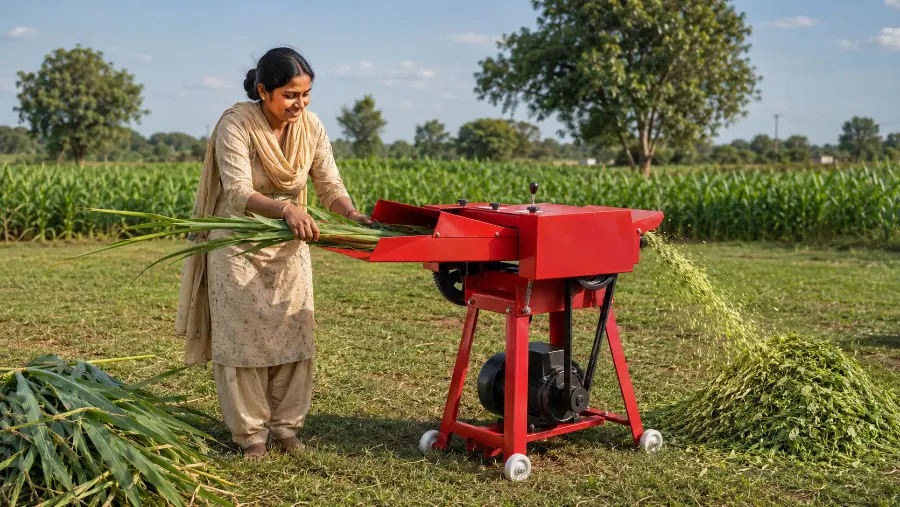
For fodder, the chaff cutter handles the dry roughage that dominates in a low-rainfall district.
Talukas we supply
Bhuj, Anjar, Mandvi, Mundra, Nakhatrana, Rapar, Abdasa, Bhachau, Gandhidham and Lakhpat.
Spraying in wind
Drift is the largest single waste of chemical in Kutch. Spray early morning or late evening when wind drops, set the boom so patterns just overlap at canopy height rather than higher, and calibrate with clean water once a season. These three habits save more than any equipment upgrade.
Call +91-8799656981 for price and delivery timeline to Kutch.
Common questions from Kutch farmers
Which reaper works on sandy soil in Kutch?
The differential reaper. Its differential lock couples both wheels when traction is lost, which is the common failure on light and sandy soils.
Do you deliver to Bhuj and Anjar?
Yes. Bhuj, Anjar, Mandvi, Mundra, Nakhatrana, Rapar, Abdasa, Bhachau and Gandhidham are all served from our Ahmedabad plant, about 330 km away.
How do I reduce spray drift in windy Kutch conditions?
Spray early morning or late evening, keep the boom low enough that adjacent nozzle patterns just overlap at canopy height, and calibrate with clean water once each season.
Machines we supply to Kutch


Nearby areas we also supply: Banaskantha · Jamnagar · Ahmedabad · All locations